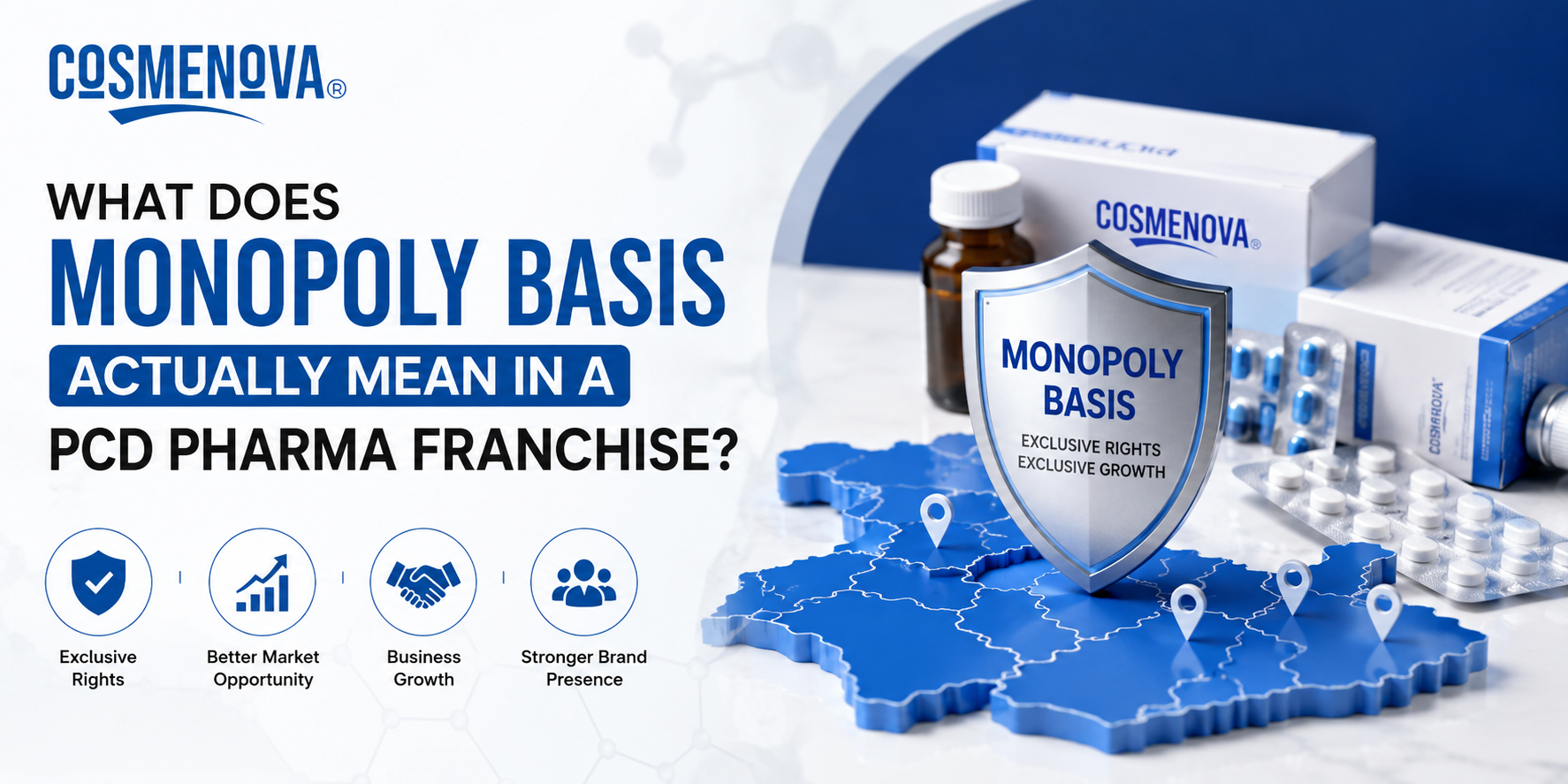
Quick answer: In the context of a PCD (Propaganda cum distribution) pharmaceutical franchise, the term “monopoly basis” implies that the pharmaceutical firm gives sole rights to the franchise partner to market, promote, and sell their product in a specific territory, which could be a district, city or even a collection of PIN codes. Other distributors, stockists, or franchises belonging to the same pharmaceutical company will not be able to conduct any business or place orders in that particular region. The term doesn’t imply that you are the sole distributor of medicines in that region but only excludes other brands from competing in the territory.
What should stick out in your mind when you consider this guide is that monopoly basis applies to brand-level territories and not category-level territories.
Monopoly Basis: The Core Definition
PCD Pharma Franchise on Monopoly Basis refers to the business relationship between a pharmaceutical firm and the appointed franchise partner who would market and distribute only one particular range of products by the pharmaceutical company in that specific area alone.
PCD stands for “Propaganda Cum Distribution”. That means the franchise partner will not only help in promoting the products but also distribute the stocks at the same time. “Monopoly” in this context has its literal meaning. The company guarantees that once the franchise is assigned, the following three conditions will apply.
- Only one franchise partner will be appointed for that particular geographical area.
- Secondly, only one franchise partner will be appointed for the entire range of products of that particular company.
- Finally, the current franchise partner will have the right of refusal in case the company decides to launch any new products or expand territories.
In simple terms, having a monopoly PCD franchise differs completely from being just a stockist of the company or being a representative of the company.
How Monopoly Basis Actually Works in Practice
After entering into a monopoly contract, things generally happen this way:
- Territory mapping – The organisation specifies the precise geographical boundary (which could be district, tehsil, city area, or pin-code area) for the monopoly contract.
- Product allocation – The company will give you monopoly rights to a particular basket of products (like cardiac-diabetic basket or general + derma basket).
- Independent working – You independently handle all matters of local marketing, order taking, management of stockists and retailers, and physician visits on your own or through your own field team.
- Organisational help – In turn, the company will provide you with visual aids, MR bags, sample kits, product cards, marketing material, and send stocks to you/your C&F/stockist place.
- Monopoly protection – In case the company breaches its monopoly contract by appointing a second player in your territory, you can claim breach of contract if the contract is written, signed, and specific.
Important Point: Monopoly right will be brand-specific, not category-specific. Another competitor company may sell a different diabetic or cardiac basket in your exact territory. Your monopoly will stop another franchisee of the same company from entering your territory.
Monopoly Basis vs. Non-Monopoly (Open) PCD Franchise
| Factor | Monopoly Basis | Non-Monopoly (Open) Basis |
|---|---|---|
| Territory exclusivity | Yes — one franchisee per zone | No — multiple franchisees can share a zone |
| Price/margin control | Higher, since no internal undercutting | Lower, due to price wars within the same brand |
| Relationship ownership | You own doctor/chemist relationships long-term | Relationships are shared and can be poached |
| Minimum order pressure | Usually moderate, tied to territory potential | Often high, to compete with rival franchisees of same company |
| Investment required | Slightly higher (₹50,000–₹5,00,000+ typical range) | Lower entry barrier |
| Long-term ROI predictability | Higher | Lower and less predictable |
| Risk of internal competition | None from the same company | Significant |
Why Monopoly Rights Matter: The Business Case
- Pricing power – With no other franchisee under the same brand undercutting you, you set the profit margins on every deal yourself.
- Relationship compounding – It takes 12-24 months for doctor prescriptions and chemist connections to develop. Monopoly gives this asset an opportunity to compound itself and not split between two players.
- Demand prediction and stocking – You can predict local disease trends (e.g. cardiac load among ageing population) and stock up accordingly without a partner splitting your information.
- Reduced customer-acquisition costs in the long run – When your market is firmly established, it becomes much less expensive than acquiring customers in a shared market area.
- Resale value – Exclusive monopoly with developed doctor network has resale or transfer value if you want to leave the game.
India’s Pharma Franchise Market in 2026: The Numbers
The monopoly PCD model sits inside one of the fastest-growing pharmaceutical markets in the world, which is exactly why territorial exclusivity has become a competitive differentiator among franchise companies. Recent industry data puts this in context:
- The value of India’s pharmaceutical market stood at USD 60.32 billion in 2026 and is predicted to grow up to USD 79.74 billion by 2031 at a CAGR of 5.74% during that period (Mordor Intelligence).
- In a longer time frame, it is anticipated to grow at a CAGR of more than 10% to reach USD 130 billion by 2030 (IBEF).
- It has grown at a CAGR of 9.43% in the last nine years and contributes nearly 1.72% to the GDP of India (IBEF).
- Pharmaceutical exports from India stood at USD 30.5 billion in FY25, which strengthens its standing as the third-biggest producer of pharma products in the world (Economic Survey 2025-26, via IBEF).
- Retail pharmacies remain the main source of pharmaceutical sales, contributing to 64.57% of total pharmaceutical sales in 2025, while online pharmacy is growing at a CAGR of 9.45% (Mordor Intelligence).
- North India remains the largest regional market share, standing at around 30% in 2025, and manufacturing centres are located in Himachal Pradesh and Uttarakhand – the same region in which most of the monopoly PCD franchise companies operate (Mordor Intelligence).
- The manufacturing market of pharmaceuticals in India itself is estimated to be worth at around USD 20.6 billion in 2025 and is anticipated to grow at a 6.37% CAGR up to 2034 (IMARC Group).
What this means for a franchisee: A market growing at 6–11% annually, concentrated heavily in generics and chronic-therapy segments, is exactly the environment where a locked, exclusive territory compounds in value year over year rather than losing share to internal competitors.
What a Genuine Monopoly Agreement Must Contain
Verbal assurance of “monopoly” is not monopoly. Verify that the contract in writing clearly mentions:
- Boundaries of the territory — names of districts, cities, tehsils or pin codes (and not vague descriptions like “your territory”)
- List of products in an annexure — so that the company can’t surreptitiously extend the product line of your competitor in the future
- Period of exclusivity — generally 1-3 years, with provision for renewal along with terms of renewal
- Minimum purchase order (MPO) — the sales target you have to achieve to continue enjoying the monopoly rights
- Breach of contract — how will the company penalise itself in case it appoints a second party in your territory
- Details of the drug license — drug manufacturing license/ marketing license number and GST details along with product certification (WHO-GMP/ISO)
- Terms of supply and payment — schedule of delivery, credit period, and return/expiry policy
Common Red Flags: When “Monopoly” Isn’t Real
The following are the red flags to look out for when considering an advance payment:
- There is an oral promise, WhatsApp, or email chat from the company about exclusivity, but not in the contract
- The territorial rights were vague and mentioned like ‘your city’ rather than clearly stated territory limits
- There was no information about the consequences of the company breaking exclusivity
- Low price of the products coupled with high security deposits required
- Lack of factory production, drug license number, and company registration details
- Use of pushy sales techniques to make you pay without analysing the contract
- There is a lack of product portfolio, MSDS, and certification proof before payment
How to Verify Monopoly Rights Before You Invest
- Get the drug manufacturing/marketing license number and verify from the website of the state drug control board.
- Write down the monopoly clause in black and white, mentioning your territory and transfer funds only after that.
- Verify that there is a WHO-GMP/ISO certificate for the manufacturing unit supplying you with the products.
- Speak to at least two partners of the same company who own franchises in another territory.
- Make sure that MOQ/MPO quantities are in numbers rather than percentages or vague language.
- Find out how renewal and termination of the contract will be done.
Frequently Asked Questions
Q: Does monopoly basis mean no other company can sell medicines in my area?
No. Monopoly basis only restricts the same company from appointing another franchisee in your territory. Competing pharma companies can still operate freely in the same area.
Q: How much investment does a monopoly PCD pharma franchise typically need?
Entry investment commonly ranges from roughly ₹15,000–₹50,000 for a basic starter range up to several lakhs for a full multi-therapy portfolio, depending on the company and product basket size — always confirm current figures directly with the company.
Q: Can a company take back my monopoly rights?
Yes, if you fail to meet the minimum purchase order (MPO) or sales targets specified in the agreement, or if the agreement term expires without renewal. This is why the MPO clause must be read carefully before signing.
Q: Is monopoly basis the same as being an exclusive distributor?
They are closely related. “Exclusive distributor” and “monopoly basis franchisee” are often used interchangeably in the Indian PCD pharma industry, both meaning sole territorial rights for one company’s brand.
Q: How long does a monopoly PCD pharma franchise agreement usually last?
Most agreements run for 1 to 3 years and are renewable, subject to the franchisee meeting agreed sales performance.
Q: What happens if the company breaks the monopoly agreement?
If the agreement includes a breach clause, the franchisee can seek compensation, refund, or legal remedy. Without a written breach clause, enforcement becomes difficult — which is why documentation matters more than verbal promises.