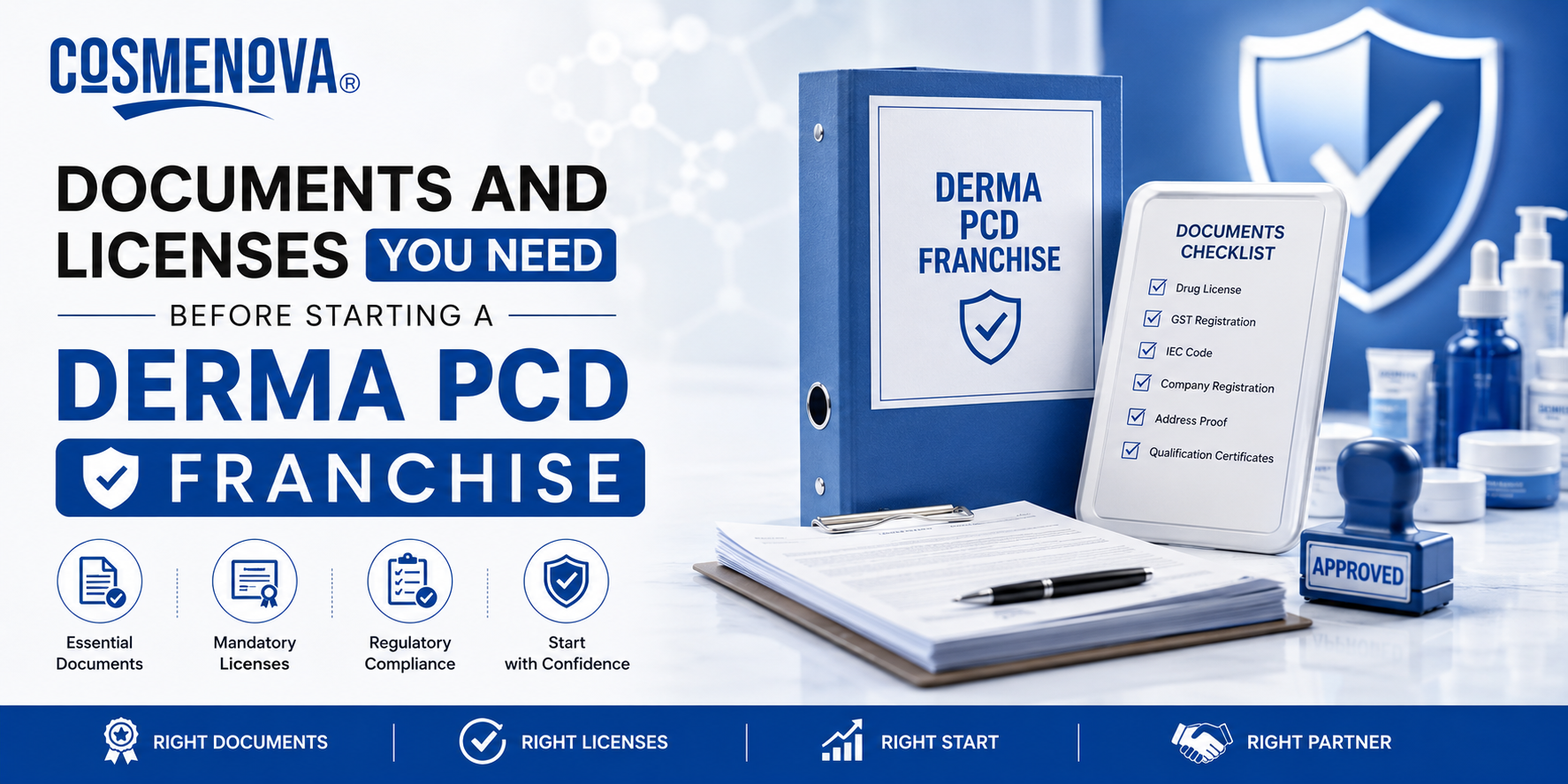
Quick answer: The legal requirements for starting a Derma PCD franchise in India involve the following seven essential factors: Drug License (Form 20B/21B or Wholesale Drug License, Form 20/21 or Retail Drug License), GST registration, PAN Card, Aadhaar Card, proprietorship/partnership/Pvt. Ltd. Proof of Business Registration, a cancelled cheque from a current bank account, and a signed franchise or distribution agreement from the derma company. If you are selling a product range comprising cosmeceutical, soap, or dietary/skin nutrients, then you must also have an FSSAI license. Your franchise application will be rejected without these two licenses.
Derma is one of the best margins within the PCD pharma segment. This is the exact reason why companies check all documents carefully before awarding the monopoly rights of the district or state. Missing/mismatched documentation is the primary cause for the delay/rejection of applications for a franchise.
Why Documentation Matters More in Derma PCD
These dermatology products are governed by two acts – the Drugs and Cosmetics Act, 1940 (for prescription creams, ointments, and tablets), and, in many cases, the Food Safety Standards Act and Regulations by the FSSAI (for soaps, nutraceutical skin supplements, and cosmeceuticals). This gives derma franchises the unique position of having to provide an additional layer of documentation over what would normally be required for other PCD franchises in cardiac or diabetes territories.
Since derma-cosmetics enjoy high-profit margins and customer loyalty, they are also much more careful when granting monopoly rights to their territories, which is why missing documentation is the quickest way to give up on the good territory to another applicant.
The Complete Document & License Checklist
| # | Document | Mandatory? | Issued By |
|---|---|---|---|
| 1 | Wholesale/Retail Drug License (Form 20B/21B or 20/21) | Mandatory | State Drug Control Department |
| 2 | GST Registration Certificate | Mandatory | GST Department (Central/State) |
| 3 | PAN Card (firm + proprietor/director) | Mandatory | Income Tax Department |
| 4 | Aadhaar Card of authorised signatory | Mandatory | UIDAI |
| 5 | Business registration proof (proprietorship declaration/partnership deed / Certificate of Incorporation) | Mandatory | Registrar of Firms / MCA |
| 6 | Current bank account + cancelled cheque | Mandatory | Business’s bank |
| 7 | Franchise/Distribution Agreement | Mandatory | Signed with the derma company |
| 8 | Passport-size photographs of authorised person(s) | Mandatory | — |
| 9 | Address proof of office/storage premises | Mandatory | Utility bill/rent agreement |
| 10 | FSSAI License | Conditional (cosmeceuticals, soaps, nutraceutical skin products) | FSSAI |
| 11 | Trade License | Sometimes required | Municipal Corporation |
| 12 | No Objection Certificate (NOC) | Sometimes required (if also running a retail medical store) | Local drug authority |
Drug License — The Non-Negotiable Document
This is the most crucial document in the entire process. Without this document, your application will never be taken seriously by a pharma company.
- Authority issuing the license: State Drug Control Department / State Drugs Standard Control Organisation
Two types of licenses available:
- License to Wholesale Drugs (Form 20B/ 21B) – needed in case your product line is distributed among hospitals, chemists, and stockists (the regular PCD franchise arrangement)
- License to Retail Drugs (Form 20 / 21) – needed in case you distribute directly to consumers
General eligibility criteria include:
- Premises area minimum requirement of about 10-15 square meters for your office/storeroom
- Registered pharmacist or a person with prescribed qualifications managing the premises (may vary from state to state)
- Correct storage conditions, cold chain management in case of temperature-sensitive derma range
Time taken to process this license: Usually takes a couple of weeks depending upon the workload of the state drugs authority and premises inspection schedule
Reasons why this license might be rejected: Lack of adequate storage space, lack of details of pharmacist, lack of premises documents, wrong address of license vs actual premises address
Deep Dive: GST Registration
GST registration is essential due to the fact that the pharmaceutical and cosmeceutical products constitute taxable goods, and hence companies are required to issue tax invoices that meet their requirements.
Importance of GST Registration:
- Allows the correct issuance of bills and tax credits as well as inter-state movement of derma products
Documents required for GST application:
- PAN, Proof of business entity registration, Proof of address, Bank Account details and photographs of authorised signatory
GST registration can only be applied for once the business entity type (proprietorship/partnership/Pvt. Ltd.) has been decided, since the GST certificate is issued in the business entity name
FSSAI License (When You Need It)
All derma franchises do not require an FSSAI license – however, in case your product range comprises the following:
- Medicated / herbal soaps which come under the category of cosmetics and consumables
- Nutraceutical/ dietary derma supplement (such as collagen packets, skin supplement tablets, etc.)
- Certain cosmeceutical claims which come under the category of food supplement rather than medicine alone
In case you have a derma range consisting of prescription creams, ointments, gels, and tablets which come under the Drugs & Cosmetics Act, you may not require the FSSAI license.
Business Registration & Identity Documents
In addition to these two important permits, some necessary documents need to be submitted to show that you are a valid, responsible entity before being given the monopoly right to the area:
- PAN Card – of the company (if partnership firm/companies) or of the proprietor (in case of proprietorship)
- Aadhar card – of the main applicant or an authorised director
- Proof of registration of the business – partnership deed, certificate of incorporation, or proprietorship
- Active bank account – with a cheque leaf, which is used for payment purposes
- Two passport-size photos – of the authorised signatory
- Proof of address – for both office and warehouse location
The Franchise/Distribution Agreement
This is the legal document by which you will enter into a relationship with the derma firm, and this document is as important as the licenses from the government. An agreement must have provisions such as:
- Territory/Monopoly Limitations – NAMED Districts/Cities/Pin Codes.
- Product Annexure – Exact Derma products (creams, lotions, serums, ointments, soaps, tablets) covered.
- Minimum Purchase Order (MPO) terms and renewal terms.
- Price and margins, payment terms and credit terms.
- Market Support terms – Visual aids, Sample kits, Product Literature.
- Breach and Termination Provisions
The oral assurance of monopoly rights does not hold any legal value – make sure that all the promises regarding territories and products are made directly in the agreement.
Derma & Skincare Market Size: Why the Paperwork Is Worth It
This regulatory initiative has proven itself very well in one of the most dynamically growing segments of the Indian pharma and personal-care industry:
- The value of the Indian dermatology market exceeded INR 16,000 crore in 2025 and grew at an approximate rate of 8% CAGR from about INR 12,000 crore in 2021 (KPMG).
- India’s skincare market size achieved USD 9.27 billion in 2025 and is expected to reach USD 18.58 billion by 2035, growing at a 7.2% CAGR (Expert Market Research).
- The derma-cosmetics and cosmeceuticals sub-segment specifically has 11-13% CAGR and is considered a premium segment in terms of high margins, mostly based on dermatologists’ recommendations (IMARC Group).
- Margins in PCD pharma franchises vary from 30% to 70%, while the dermatology and gynaecology sub-segments can be considered as high as 55-70% (Ernst Pharmacia).
- The facial care products themselves account for about 42.5% revenue share of India’s skincare market owing to growing popularity of serums, sunscreens, and special treatment products (IMARC Group).
Conclusion for franchisee: Derma is no longer a minor category. It is a rare case when both the growth rate of the market itself (7-13% CAGR of sub-segments) and margins of the franchisee (up to 70%) exceed those of other pharmaceutical segments. This is exactly the reason why companies have stricter requirements concerning the documentation before granting the exclusive territory.
Step-by-Step: How to Get Your Documents Ready
- Select your business model – Proprietorship, Partnership, or Pvt. Ltd. because all subsequent documents are issued in the name of this entity.
- Ensure your premises – office space and storage which should meet the required area and storage condition criteria to get your drug license.
- Get your drug license through the State Drug Control Department by applying through the Wholesale Form 20B/21B, as this is the usual way for PCD franchising.
- File for GST registration and ensure your registered address is exactly the same as the one you applied for the drug license.
- Collect your identity and bank documents – PAN card, Aadhaar, Cancelled Cheque, photographs.
- Only apply for the FSSAI license if your product line consists of soaps, nutraceuticals, or supplements.
- Select your derma PCD company and review your franchise agreement clause by clause before finalising.
- Submit the whole package at once – incomplete submission is the most frequent reason for delays in processing.
Common Mistakes That Delay or Reject Applications
- A submission of a drug license which has already lapsed or is about to lapse
- Mismatching of GST with the address of office or warehouse
- Submission of a license with incomplete business registration (pages missing in the partnership deed, proprietorship declaration unsigned)
- Signing of the franchise agreement without defining the territories and the product annexures in writing
- Omission of the need for an FSSAI license for products like soap or nutraceutical skin supplements
- Use of a personal bank account instead of a business bank account for franchise payment
Frequently Asked Questions
Q: Is a Wholesale Drug License enough to start a Derma PCD franchise?
In most cases, yes — a Wholesale Drug License (Form 20B/21B) is sufficient for distributing derma products to chemists, hospitals, and stockists. A Retail Drug License is only needed if you also plan to sell directly to patients.
Q: Do I need an FSSAI license for a derma franchise?
Only if your product range includes items regulated as cosmetics-cum-consumables or nutraceuticals, such as medicated soaps or skin-health supplements. Pure prescription creams, gels, and tablets under the Drugs and Cosmetics Act typically don’t require FSSAI registration.
Q: How long does it take to gather all the documents?
Most applicants report the full process — drug license, GST registration, and supporting paperwork — takes around 2 to 4 weeks, depending on how quickly the state drug authority processes the license and inspects the premises.
Q: Can I start with a Retail Drug License instead of Wholesale?
It depends on your business model. If you intend to distribute to chemists, hospitals, and other retailers (the standard PCD structure), you need a Wholesale Drug License. A Retail license alone is not sufficient for franchise-style distribution.
Q: What happens if my GST address doesn’t match my drug license address?
This is one of the most common reasons applications get delayed or rejected outright. Both addresses should point to the same verified business premises before you apply for either registration.
Q: Do I need a separate license for cosmetic-only derma products versus medicated ones?
Medicated/prescription derma products fall under the Drugs and Cosmetics Act and need a drug license. Pure cosmetic products may fall under cosmetic-specific regulations, and cosmeceuticals with supplement-style claims may additionally need FSSAI registration — always confirm classification with the company and, if needed, a regulatory consultant.