The demand for dermatology and skincare products has been growing steadily in India. As awareness about skincare, hair care, acne, pigmentation, and other dermatological concerns has increased, a wider range of derma products is being used by consumers and healthcare professionals.
Because of this growing demand, a derma PCD pharma franchise in India is being considered by many entrepreneurs, distributors, medical representatives, and pharma professionals. However, the success of a franchise business is largely influenced by the company selected for the partnership.
Many derma PCD companies in India offer attractive product ranges, promotional support, monopoly rights, and competitive pricing. However, every company may not provide the same level of quality, support, manufacturing standards, and business assistance.
Therefore, a proper evaluation should be carried out before a franchise agreement is signed.
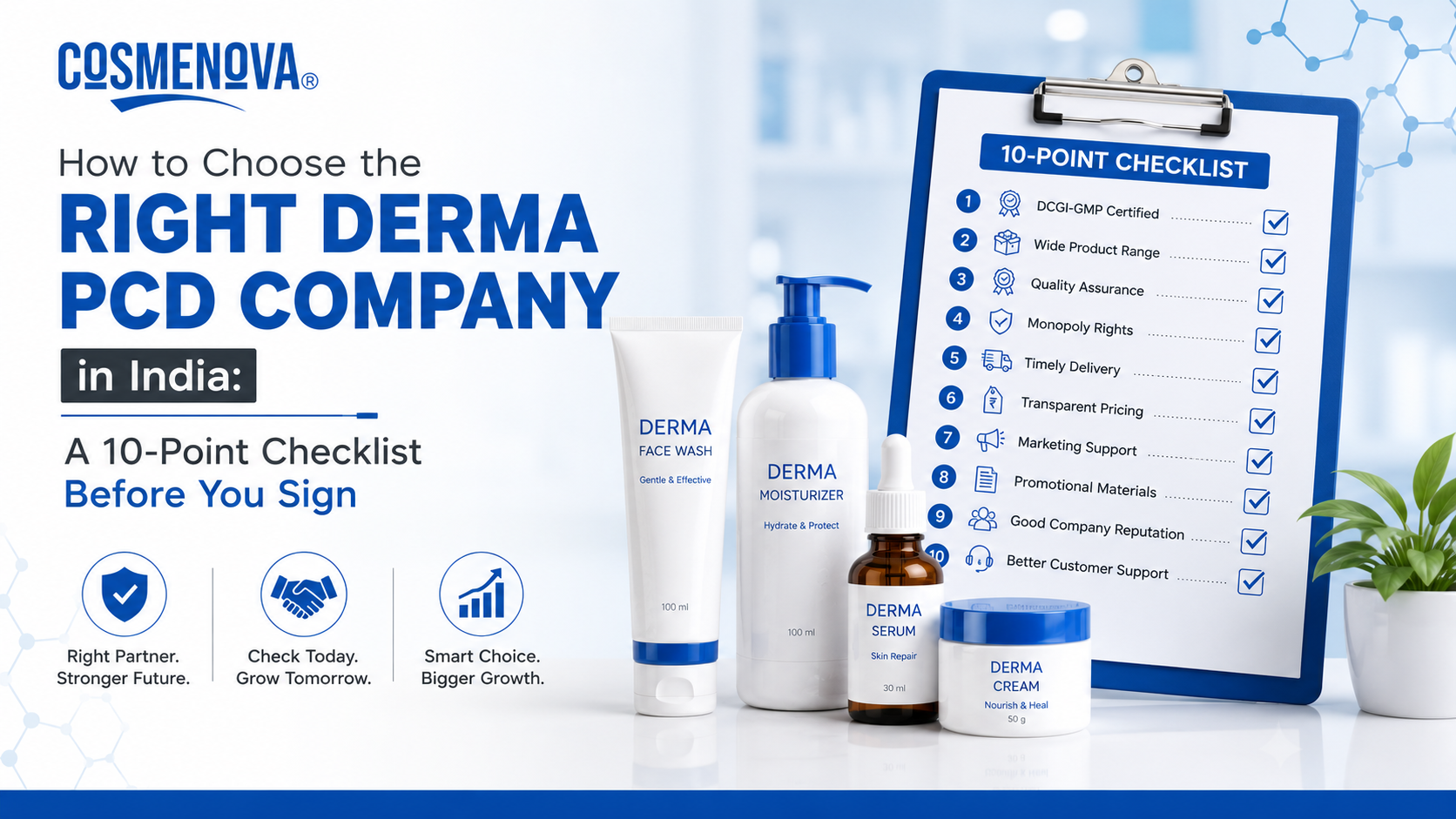
This 10-point checklist for choosing a derma PCD company in India can help important factors be evaluated before making a final decision.
10-Point Checklist to Choose the Right Derma PCD Company in India
1. Check the Company’s Pharmaceutical Certifications and Licences
The first factor that should be checked is the company’s legal and regulatory compliance.
A genuine derma PCD pharma company in India should have the necessary pharmaceutical licences and regulatory documentation required for its operations. Depending on the products and manufacturing arrangement, relevant licences, approvals, and certifications should be available.
Documents related to manufacturing and quality standards should be requested and verified before the partnership is finalised. The following may be checked:
- Drug manufacturing or marketing licences
- GMP certification
- WHO-GMP certification, where applicable
- ISO certification
- Product-related approvals and documentation
- GST registration
- Company registration details
It should also be confirmed whether the products are being manufactured through an authorised facility.
Proper documentation provides greater confidence that the business is being operated according to applicable pharmaceutical standards.
2. Evaluate the Quality of Derma Products
Product quality should never be compromised when a derma PCD franchise is being selected. Dermatology products are used for sensitive skin conditions, infections, acne, pigmentation, hair concerns, and several other applications. Therefore, consistent quality is particularly important. The product range should be evaluated for:
- Quality of active ingredients
- Formulation standards
- Product stability
- Packaging quality
- Shelf life
- Batch consistency
- Storage requirements
- Manufacturing standards
Product samples can also be requested before an order is placed. A company offering a large product range should not automatically be considered the best option. Greater importance should be given to quality, consistency, safety, and reliability.
3. Look for a Strong and Relevant Derma Product Range
A well-planned product portfolio can make a major difference in a derma pharma franchise business. The selected company should have a product range that covers commonly demanded dermatology categories. A balanced portfolio allows different products to be promoted to dermatologists, skin clinics, hospitals, and pharmacies.
A derma range may include:
- Anti-acne products
- Anti-fungal creams and tablets
- Anti-bacterial preparations
- Steroid and combination products, where legally appropriate
- Moisturizers
- Sunscreens
- Cleansers
- Anti-pigmentation products
- Hair growth and hair care products
- Scalp care products
- Cosmeceuticals
- Skin supplements
The portfolio should also be assessed for market demand. Products that are difficult to position or have limited demand may result in slower inventory movement.
4. Compare Product Prices and Profit Margins
Pricing is another important factor when a derma PCD company in India is being selected. A franchise business should have a commercially practical pricing structure. Product prices should be compared with similar products available in the market. The following should be evaluated:
- Purchase price
- MRP
- Retailer margin
- Distributor margin
- Promotional schemes
- Special discounts
- Minimum order requirements
- Transportation costs
A high margin may look attractive initially, but it should not be considered alone. Product demand, quality, repeat orders, and market acceptance are equally important. A reasonable combination of product quality, competitive pricing, and healthy margins should be preferred.
5. Check for Monopoly Rights in the Area
Monopoly rights are one of the major advantages offered under a PCD pharma franchise model. When monopoly rights are provided for a particular territory, the same product portfolio is generally not offered to another franchise partner within that defined area, subject to the company’s terms and agreement. Before signing an agreement, the territory should therefore be clearly discussed. The following details should be confirmed:
- Exact geographical area
- District or city coverage
- Availability of monopoly rights
- Conditions attached to the rights
- Renewal terms
- Minimum purchase requirements
- Whether the rights are mentioned in writing
6. Assess the Company’s Marketing Support
Marketing support can make the initial stages of a derma PCD franchise business much easier. A good company should ideally provide useful promotional materials that can support product communication and brand building. Depending on the company, franchise support may include:
- Visual aids
- Product cards
- Doctor folders
- Product literature
- Promotional gifts
- Reminder materials
- Product catalogues
- Digital marketing materials
- Samples, where applicable
The quality of marketing materials should also be assessed. Materials should be professional, informative, and suitable for pharmaceutical promotion. A company that provides regular marketing assistance can help franchise partners build stronger product visibility in their assigned territory.
7. Verify Manufacturing Facilities and Quality Control
The manufacturing facility behind a product portfolio should be investigated before a long-term association is established. Some derma PCD companies operate their own manufacturing facilities, while others work with third-party manufacturers. Neither model should automatically be considered better or worse. What matters is whether the manufacturing process is carried out through a reliable and compliant facility. Information about the manufacturing facility, quality control systems, testing procedures, and certifications should be checked. Attention should be given to:
- Raw material quality
- Manufacturing practices
- Quality testing
- Packaging standards
- Batch testing
- Storage conditions
- Quality control procedures
8. Check Product Availability and Delivery System
Even high-quality products may become difficult to sell if regular availability cannot be maintained. For a derma PCD pharma franchise in India, consistent product supply is particularly important because prescriptions and repeat demand can depend on regular availability. The company’s supply system should therefore be evaluated.
Important questions include:
- How quickly are orders dispatched?
- Are products normally kept in stock?
- How are out-of-stock situations handled?
- Which locations are covered for delivery?
- How are damaged products handled?
- What is the replacement policy?
- How is short-expiry stock managed?
A reliable supply chain reduces the risk of missed sales and helps maintain better relationships with retailers and healthcare professionals.
9. Read the Franchise Agreement Carefully
A franchise agreement should never be signed without understanding its terms. The agreement should clearly mention the business relationship and the responsibilities of both parties. Important terms to check include:
- Territory rights
- Product supply terms
- Pricing
- Payment conditions
- Minimum order requirements
- Credit terms, if offered
- Replacement policy
- Expiry policy
- Promotional support
- Termination conditions
- Renewal conditions
A written agreement provides greater clarity and can help prevent misunderstandings at a later stage.
10. Research the Company’s Reputation and Track Record
The final and one of the most important checks is the company’s reputation. A best derma PCD company in India should not be selected only because of an attractive product catalogue or high promotional claims. Its market reputation should also be investigated. Reviews and feedback from existing franchise partners can provide useful insights into the company’s actual working process. Information should be gathered about:
- Product quality
- Order fulfilment
- Customer support
- Payment terms
- Marketing assistance
- Complaint handling
- Product availability
- Franchise partner satisfaction
A company with a consistent track record is generally more suitable for a long-term business relationship.
Red Flags to Watch Before Choosing a Derma PCD Company
While comparing derma PCD companies in India, certain warning signs should be taken seriously. These may include:
- Unclear or missing pharmaceutical documentation
- Extremely low prices without a reasonable explanation
- Poor-quality packaging
- No proper product information
- Unclear monopoly terms
- Pressure to make immediate payments
- No written agreement
- Poor communication after payment
- Frequent stock shortages
- Unclear replacement or expiry policies
- Unrealistic income or sales guarantees
Questions to Ask Before Selecting a Derma PCD Company
Before finalising a company, the following questions should be asked:
- Are all required pharmaceutical licences and certifications available?
- Where are the products manufactured?
- Is the manufacturing facility GMP compliant?
- What products are included in the derma range?
- What is the minimum order quantity?
- Is monopoly rights protection provided?
- What territory will be available?
- What marketing support will be provided?
- What is the product replacement policy?
- How are near-expiry or damaged products handled?
- What are the payment terms?
- How long does product delivery normally take?
- Is a written franchise agreement provided?
Final Words
Selecting the right derma PCD company in India is one of the most important decisions to be made before starting a dermatology-focused pharma franchise. Attractive margins or a large product catalogue alone should not be used as the deciding factors.
Product quality, certifications, manufacturing standards, monopoly rights, pricing, marketing assistance, product availability, agreement terms, and company reputation should all be evaluated.
A proper 10-point checklist for choosing a derma PCD company can help potential franchise partners compare companies more objectively and avoid common mistakes.
With the right pharmaceutical company and a well-planned territory, a derma PCD pharma franchise in India can be developed as a sustainable business opportunity in the growing dermatology market.
Frequently Asked Questions About Derma PCD Companies in India
What certifications should be checked before choosing a derma PCD company?
Relevant pharmaceutical licences and applicable quality certifications should be checked. GMP, WHO-GMP, and ISO certifications may also be considered depending on the company’s manufacturing and quality systems.
Is monopoly rights important in a derma PCD franchise?
Yes. Monopoly rights can provide territory protection and reduce direct competition from another franchise partner of the same company within the agreed area. The terms should always be confirmed in writing.
How much investment is needed to start a derma PCD franchise?
Investment varies according to the company, product range, initial order, territory, promotional support, and other business requirements. Usually you can start Derma PCD franchise with the minimum investment of Rs. 50,000 to Rs. 2,00,000.
Is it better to choose a company with a large product range?
Not necessarily. A large product range can be useful, but product quality, market demand, pricing, availability, and company support should also be considered. A focused and relevant derma portfolio may be more useful than a very large but poorly positioned range.