Starting a cosmetic business in India can be a good opportunity for entrepreneurs who are interested in skincare, makeup, haircare, and personal care products. But before investing, it is important to understand what is the profit margin in cosmetic products in India and how much you can realistically earn.
The profit margin depends on the product you sell, manufacturing costs, packaging, marketing expenses, and sales channels. For example, a serum sold for ₹599 may generate a good gross margin, but advertising, shipping, discounts, and other expenses can reduce your actual profit. Moreover, as per industry reports, the Indian cosmetics market is growing rapidly and is expected to expand from around USD 1.89 billion in 2025 to USD 3.5–3.6 billion by 2031, with a projected 10.85% CAGR between 2026 and 2031.
In this guide, we will explain the profit margin in cosmetic products in India, compare different cosmetic business models, and show practical calculations.
Quick Summary: What Is the Profit Margin in Cosmetic Products in India?
- Profit margins vary: Profit margins depend on the cosmetic product, selling price, business model, and operating costs.
- Gross profit margin: The profit left after subtracting the cost of manufacturing or purchasing products from net sales.
- Net profit margin: The profit remaining after deducting other expenses, such as marketing and shipping, salaries, and administration.
- Different business models: Private-label brands, online sellers, distributors, and retailers have different costs and profit margins.
- Calculate all costs: Include manufacturing, packaging, marketing, delivery taxes, and other business expenses before estimating your profit.
- Focus on actual profit: A product with a high markup does not always generate high net profit because other expenses can reduce your earnings.
Understanding Profit Margins in the Cosmetic Business
Profit margin tells you how much money your cosmetic business keeps from its sales after deducting costs. There are two important types of profit margins: gross profit margin and net profit margin. Understanding both profit margins helps you set the right product prices, control expenses, and estimate how much your cosmetic business can actually earn.
Gross Profit Margin
Gross profit margin shows how much profit you make after deducting the cost of manufacturing or purchasing your cosmetic products.
Formula:
Gross Profit Margin = (Net Sales − Cost of Goods Sold) ÷ Net Sales × 100
Example: If you sell a cosmetic product for ₹500 and its manufacturing cost is ₹200, your gross profit is ₹300, giving you a 60% gross profit margin. This assumes ₹200 includes all costs counted under the cost of goods sold.
Net Profit Margin
Net profit margin shows how much money remains after paying all business expenses, including marketing, shipping, salaries, discounts, interest, and taxes, where applicable.
Formula:
Net Profit Margin = (Net Profit ÷ Net Sales) × 100
Example: If your cosmetic business earns ₹500 in net sales and makes ₹50 in net profit after all expenses, your net profit margin is 10%.
Cosmetic Market’s Overview
Before you step into a deep understanding of the Profit margin of cosmetic products in India, Cosmenove provides an overview of the cosmetic market in India.
The Average Profit Margin in the Indian Cosmetic Business
In India, the average cosmetic brands make anywhere between 25- 65% in terms of gross profit margin. An established luxury brand or niche skincare brand can easily earn more than 70-80%. But there is a fine line to distinguish gross profit (amount after subtracting production costs from selling price) and net profit (money that is in your bank account after you pay for shipping costs, platform commissions, payroll, marketing & digital media, etc.). If you have an idea where your money goes here’s the real-life calculation of a standard face serum for ₹599, which is sold on an e-commerce platform in India:
| Expense Component | Estimated Cost (INR) |
| Core Formulation & Liquid Bulk | ₹70 |
| Outer Packaging & Bottle | ₹40 |
| Label Printing & Coding | ₹10 |
| Logistics & Shipping Costs | ₹35 |
| Influencer Marketing & Meta Ads | ₹90 |
| E-commerce Marketplace Commission (e.g., Nykaa, Amazon) | ₹60 |
| Miscellaneous Overhead Costs | ₹20 |
| Total Cost of Operations | ₹325 |
| Retail Selling Price (MSRP) | ₹599 |
| Net Profit Margin | ₹274 (-45.7%) |
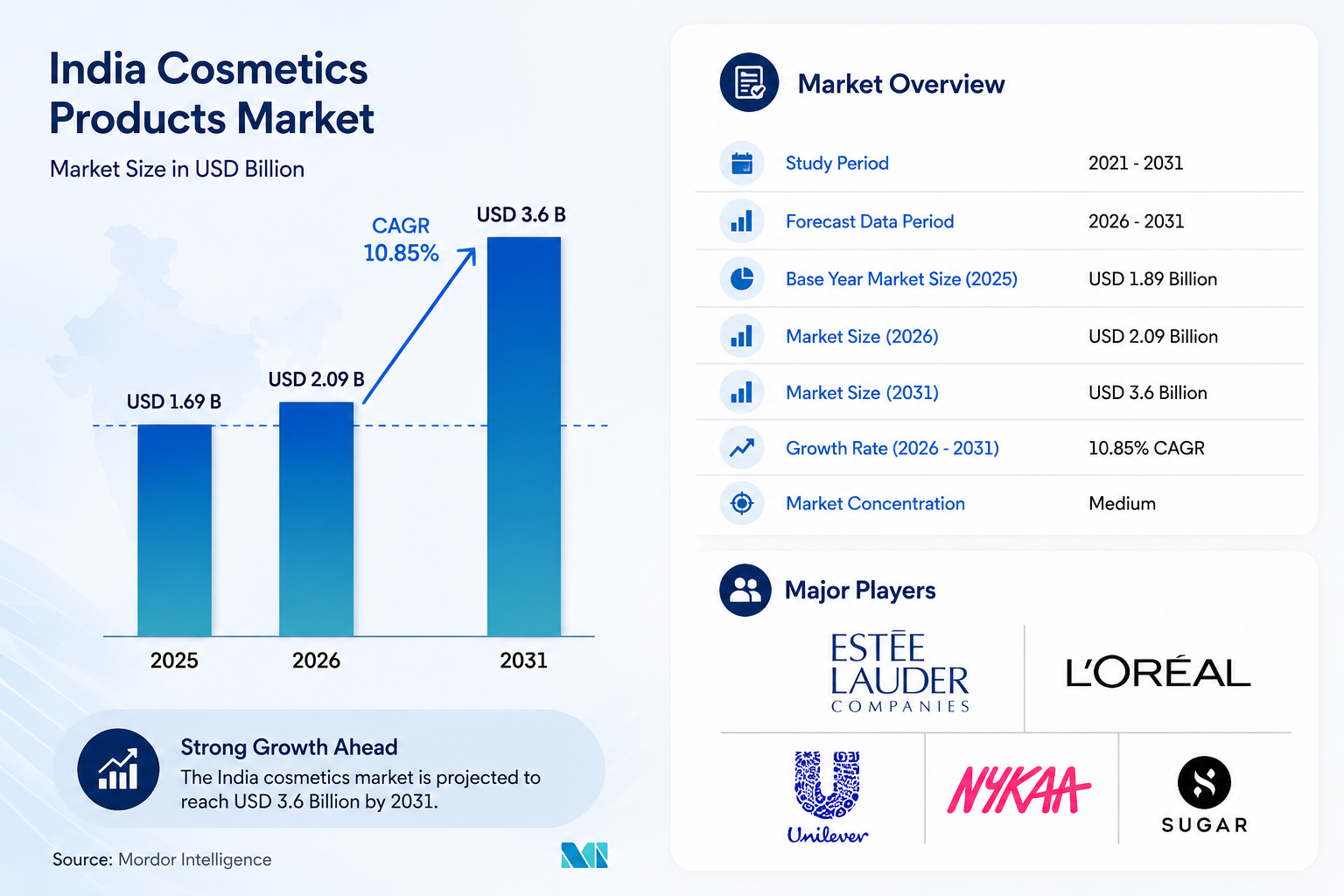
The report covers market data from 2021 to 2031, with 2026–2031 representing the forecast period. The market has medium concentration, with major players including Estée Lauder, L’Oréal, Unilever, Nykaa, and SUGAR. Overall, the strong projected growth indicates increasing opportunities for cosmetics brands, manufacturers, and businesses operating in the Indian beauty and personal care sector.
Key Report Takeaways
- Mass-market cosmetics made up the largest share of sales in 2025, accounting for 79.55% of the market. At the same time, premium and luxury cosmetics are expected to grow quickly, at 12.55% per year through 2031.
- Lip makeup was the most popular product type in 2025, making up 36.12% of the market. However, eye makeup is expected to grow faster, at 11.55% per year until 2031.
- Traditional or conventional cosmetics still dominate the market, with an 88.74% share in 2025. However, natural and organic cosmetics are gaining popularity and are expected to grow at 12.17% per year through 2031.
- Online shopping is becoming an important way for people to buy cosmetics. Online sales accounted for 30.95% of the market in 2025 and are expected to grow at 11.15% per year until 2031.
- North India had the largest share of the cosmetics market in 2025, accounting for 39.54%. However, West India is expected to be the fastest-growing region, with an annual growth rate of 11.82% through 2031.
Profit Margin Breakdown by Product Category
Not all beauty products offer the same returns. If your business strategy revolves around high volume, mass-market items will yield different percentages than premium anti-ageing treatments.
1. Skincare Products (45%-70% Gross Margin)
The skincare sector claims over 32% of India’s cosmetics market, but the consumer-perceived clinical nature of face serums, sunscreens, and specific moisturising creams makes them susceptible to high prices due to the high concentration of active ingredients (Hyaluronic Acid, Vitamin C or Retinol, etc.), while keeping the chemical manufacturing costs very low.
2. Colour cosmetics and makeup (50%-80% Gross margin)
Lipsticks, eye makeup, highlighters and foundations command among the highest gross margins in cosmetics. Lip makeup is taking over a 36% share in the cosmetics products market in 2025, whereas eye makeup is growing fast (CAGR 11.55%). The desire to buy colour cosmetics is driven heavily by contemporary aesthetics; thus, colour cosmetics can be very suitable for selling at higher margins via social media.
3. Ayurvedic, Herbal & Clean Beauty (30% – 55% Gross Margin)
The growth in the clean beauty category in India has been a spectacular 15.7% CAGR, thanks to the increasing conscious shift from synthetic sulphates and parabens. While the demand for organic products is in high order, procurement of pure herbal extracts, plant oils, and obtaining organic certifications raises the manufacturing cost slightly, giving rise to a decent 30-55% gross margin but excellent customer retention.
4. Men’s Grooming (35% – 60% Gross Margin)
Growing at a CAGR almost double that of the women’s grooming segment and projected to be worth over 27,500 crores by 2027, the men’s grooming segment, where products such as beard oils, charcoal face washes, and solid colognes are making inroads, is one where there is a large segment of unsatisfied customers with great retention and minimal price sensitivity.
Profit Margins Based on Your Business Model
Your operational framework plays a massive role in determining your final take-home revenue. Let’s compare how different business setups yield different profit margins in India:
Private Label and Contract Manufacturing (50% – 70%+)
By partnering with a certified third-party cosmetic manufacturer, you avoid investing in an expensive R&D custom lab or owning your own manufacturing facility. You pick approved, safe formulations, place your private branding, and will have access to elite margins thanks to smaller starting capital expenditures.
Online Reselling and D2C Brands (25% – 40%)
Using a Direct to Consumer (DTC) e-commerce storefront on a platform like Shopify, WooCommerce, or Magento has absolutely zero real estate friction. However, you may be offsetting a portion of rent and overhead toward paying for digital customer acquisition.
Wholesale Distribution Channels (20% – 35%)
Working as a B2B cosmetics bulk distributor involves shipping large quantities directly to individual local retailers, salons, or regional multi-brand chains. Your unit margin will take a hit, but you will have access to larger quantities of cash and have a dependable, steady revenue stream.
Pro-Tips to Maximise Margins for Modern Beauty Brands
To stay competitive against giants like Unilever, L’Oréal, and fast-growing Indian players like SUGAR Cosmetics or Mamaearth, leverage these modern operational strategies:
To be optimised for Quick Commerce
Beauty order volumes on quick-commerce platforms like Blinkit, Zepto, and Instamart surged almost 39%, with over 70% beauty orders in top metros being placed using ultra-fast delivery window systems. Aligning stock to quick-commerce warehouses encourages immediate re-purchases.
To be targeted towards Tier-2/Tier-3 Cities
Than 55% of the volume of beauty purchases at a prestige brand level on premium platforms comes from beyond the metros. With rental savings as high as 40-60% for commercial spaces in Tier 2 cities, the offline multi-brand retail store structure maintains a significant day 1 profitability.
Shorten the Checkout Funnel
As per current rates, around 75% of shopping cart abandonment plagues the Indian cosmetics industry. Single-click purchase funnel implementation(like one-touch OTP pop-ups, auto-fill of phone numbers, etc) can lead to a reduction in abandonment rates.
Conclusion
Indian beauty markets offer strong business opportunities, with potential gross profit margins ranging from 25% to 65%, depending on the product and business model. However, advertising costs, marketplace commissions, and shipping expenses can reduce net profits. To build a sustainable cosmetic business, focus on cost control, private-label manufacturing, and growing sales through channels such as quick commerce.
Planning to launch your own cosmetic brand? Partner with a reliable third-party cosmetic manufacturer to explore product customisation, packaging options, and cost-effective production. Contact our team today to discuss your manufacturing requirements and take the first step towards building your beauty brand.
FAQs (Frequently Asked Questions)
What is the difference between markup and profit margin?
Markup measures profit relative to cost, while profit margin measures profit relative to selling revenue. For example, a product costing ₹100 and selling for ₹150 has a 50% markup and a 33.3% gross profit margin before other expenses.
Which cosmetic products can offer better profit margins?
Face serums, moisturisers, makeup products, sunscreens, and specialised skincare products may offer attractive gross margins in some business models. Actual profitability depends on formulation costs, competition, pricing, demand, and customer acquisition expenses.
What is the profit margin in the cosmetic wholesale business?
Cosmetic wholesale margins depend on purchase prices, brand agreements, order volumes, retailer discounts, freight, storage, and payment terms. Wholesalers generally need to balance profit per unit with sales volume and inventory turnover.
Does premium packaging increase cosmetic business profits?
Premium packaging may help a cosmetic brand position its products at a higher price point, but it also increases costs. Its financial benefit depends on whether customers value the packaging enough to support the additional expense.