Key Takeaways
- The bare minimum required by law is a valid license issued by the CDSCO under the Cosmetics Rules, 2020.
- ISO 22716 Certification proves that the manufacturing company complies with international standards of Good Manufacturing Practice (GMP) for cosmetics.
- BIS certification is required for specific products like toothpaste and hair dye according to Indian Standards.
- ISO 9001 & 14001 show commitment to quality and the environment, though they do not pertain specifically to cosmetics.
- Organic, cruelty-free, vegan, and Halal certifications become significant in case your brand makes specific claims about them on its packaging or is meant for export.
- Always seek original certifications, cross-check them with the authority issuing the certification, and verify their validity period and scope before going ahead with the manufacturing process.
Selecting a cosmetic manufacturer is arguably one of the most crucial decisions a beauty brand can make. This is because choosing the right manufacturing partner influences safety, compliance with regulations, product shelf-life, and most importantly, consumer confidence. One of the most straightforward ways to assess a manufacturing partner is through certification. Certifications reveal whether or not a manufacturing plant complies with certain safety and hygiene protocols. This article outlines all the certifications that a potential cosmetic manufacturing partner should have before making a decision.
Why Do Certifications Matter When Choosing a Cosmetic Manufacturer?
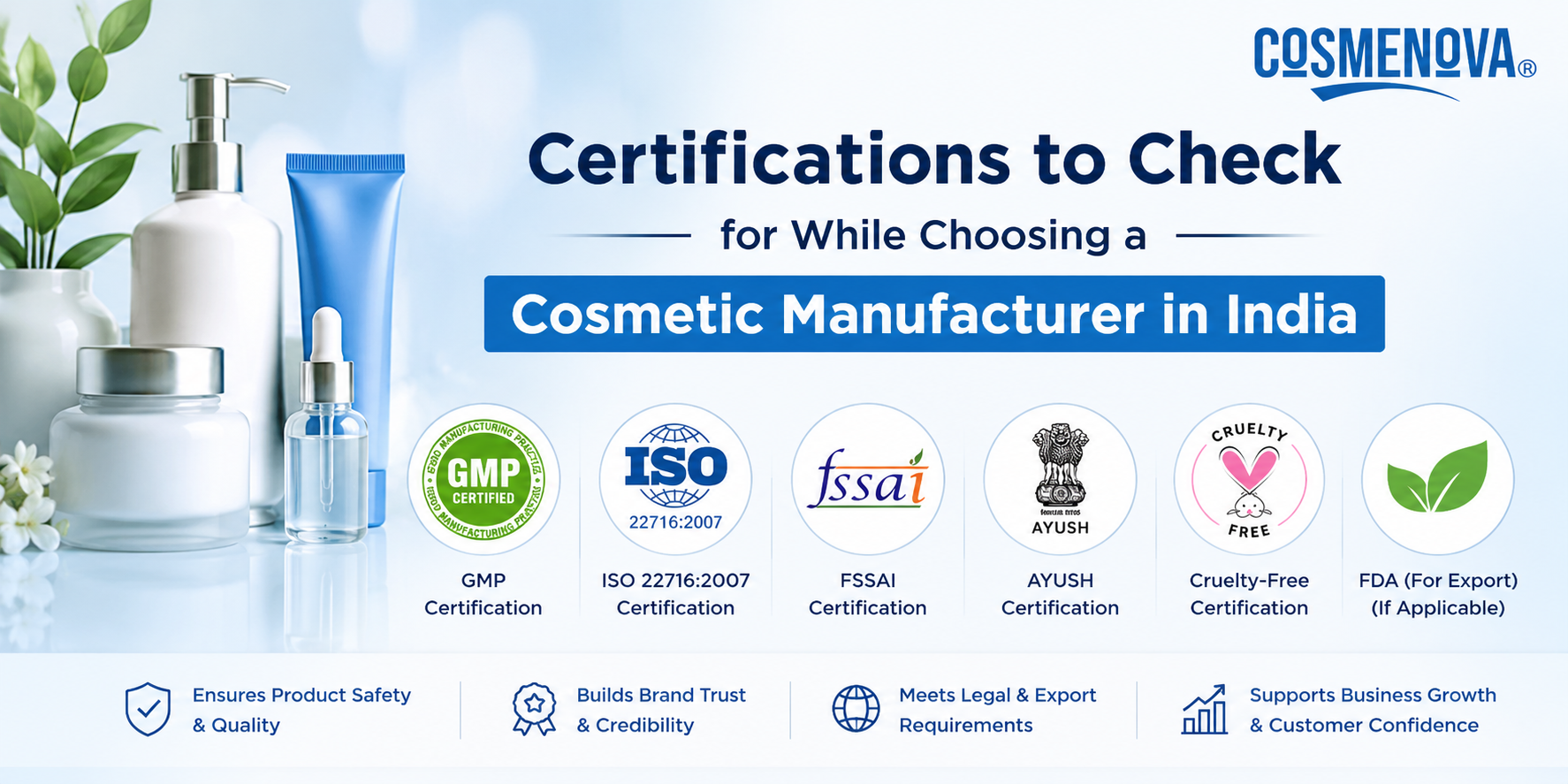
Products used in cosmetics can be directly applied to the skin, hair, and in some cases, to the mucous membranes, meaning that any lapses in the production process can result in contamination, allergy, or even product degradation. Certification is one way of providing external confirmation that the standards are met by the manufacturer in their production facilities and processes — not just relying on what the manufacturer says. It is also important from a legal perspective, as there may be penalties imposed for not having the required license.
List of Documents that a Cosmetic Manufacturer in India Must Have
We have compiled a list of the essential documents that any cosmetic manufacturer must hold. Here is the list.
1. CDSCO Manufacturing License (Mandatory Legally)
Manufacturing of cosmetics in India is regulated by the Central Drugs Standard Control Organisation (CDSCO) as per the Cosmetics Rules, 2020. Every legal cosmetic manufacturer must be registered with a valid manufacturing license provided by the State Licensing Authority via the CDSCO’s SUGAM portal. The license ensures that the manufacturing plant has been inspected and authorised to manufacture cosmetics in India legally.
When choosing a manufacturer, request the license number along with the product range of cosmetics they can manufacture because some of these licenses have restrictions on the kinds of cosmetics being produced. Manufacturers not having this license are operating illegally irrespective of how well-equipped they might be.
2. ISO 22716 – Cosmetics Good Manufacturing Practices (GMP)
ISO 22716 is the international standard formulated specifically for the cosmetics sector, addressing manufacturing, quality control, storing, and shipping of cosmetics. This international standard is unlike the general good manufacturing practices and focuses only on cosmetics.
This certification is not always legally mandatory in India, but it has become the practical benchmark most serious brands look for, since it demonstrates the manufacturer follows the same standards required for exporting to markets like the EU, US, and other regulated regions. If you plan to export your products eventually, partnering with an ISO 22716-certified manufacturer from the start can save significant rework later.
3. BIS Certification (Compulsory for Certain Cosmetics Categories)
As per the regulations set by the Bureau of Indian Standards (BIS), certification is required for some categories of cosmetics based on some Indian standards, such as toothpaste and hair dyes. The products need to follow the BIS standards in order to be available for sale. Hence, if the product belongs to any of the categories mentioned above, it is important to ensure that there is BIS certification from the manufacturing unit.
4. ISO 9001 – Quality Management System
ISO 9001 is a broad category of quality management system certification and is not specific only to the cosmetics industry. This implies that the manufacturing unit has systems in place that can prove the quality control system, along with regular training of employees. Even though it is not a substitute for other certifications such as ISO 22716, it is a good way to assess consistency.
5. ISO 14001 – Environmental Management System
ISO 14001 indicates that the manufacturer has developed procedures that are systematically managed to reduce their environmental impact, which can include waste management, energy consumption, and resource efficiency. Such a certification becomes increasingly important when you would like to present your brand as environmentally responsible, and in general, can indicate a well-managed facility.
6. WHO-GMP Certification
Several Indian manufacturers, especially those who produce pharmaceutical or nutraceutical products, have WHO-GMP (World Health Organisation Good Manufacturing Practices) certification. It is generally considered an attribute of pharmaceutical manufacturing facilities, but when a facility has WHO-GMP along with cosmetic certifications, it means they are paying very close attention to hygiene and quality management.
7. AYUSH License (For Ayurvedic and Herbal Cosmetics)
If your product range includes traditional and/or herbal formulations, make sure that the manufacturer has an AYUSH license issued by the Ministry of AYUSH, Government of India. The AYUSH license confirms that the manufacturer is permitted to produce Ayurvedic, Unani, and/or Siddha-based cosmetics under the rules of traditional medicine and cosmetology.
8. Organic Certification (ECOCERT, USDA Organic, NPOP/India Organic)
In case the product range includes any “organic” formulas, check that the manufacturer has the capability of manufacturing formulations based on a certified organic standard, such as ECOCERT, USDA Organic or National Programme for Organic Production (NPOP/India Organic mark) organic standards. This certification ensures that organic sources of ingredients are used, and no synthetic compounds are allowed, as the use of “organic” in the absence of certification may be illegal.
9. Cruelty-Free and Vegan Certifications
In cases where a brand offers cruelty-free or vegan products, ensure that there is certification from credible organisations (like the global cruelty-free Leaping Bunny program or vegan certification marks). It normally means the brand will have certified that no animal testing was carried out and, for the vegan certification, the product does not have animal components in its formula.
10. Halal Certification (For Export and Targeted Markets)
When targeting consumers in the Middle Eastern countries or Southeast Asian countries, halal certification becomes vital. Halal certification will assure the consumer that the ingredients used and the manufacturing process are in agreement with halal guidelines.
11. Free Sale Certificate (For Export-Oriented Brands)
A Free Sale Certificate (FSC) confirms that a product is legally manufactured and sold in India and is often required by importing countries as part of their own regulatory approval process. If you’re planning to export, check whether your manufacturer has experience helping brands obtain this document, since it’s frequently requested by overseas regulatory authorities and distributors.
How to Verify a Manufacturer’s Certifications
Instead of asking for screenshots or expired certificates, ask for a valid one
- Verify the certification number against the organisation issuing the same (SUGAM portal of CDSCO, BIS, or ISO certification issuing agency)
- Verify the scope of certification, as some licenses apply to certain product lines only
- Verify the certificate’s validity and its renewal
- A plant inspection report may also be asked for
- Make sure there is a match between claimed certifications and the plant visit observation
Which Certifications Matter Most for Your Brand?
- Only Domestic Brand: Standard cosmetic products – The minimum requirement is a CDSCO manufacturing license; ISO 22716 serves as a strong complement.
- Export-Oriented Brand: ISO 22716, Free Sale Certificate, and Halal certificate (in case you are selling in such markets).
- Ayurveda or Herbal Product: Alongside the regular CDSCO license, it should have an AYUSH license.
- Organic or Clean Beauty Product: ECOCERT, NPOP/India Organic, and USDA Organic are the certifications that are a must for any product claiming to be organic.
- Cruelty-Free or Vegan Product: Cruelty-free and vegan certification by the manufacturer.
- Products under BIS regulation (toothpaste and hair dye): BIS certification is mandatory here.
Frequently Asked Questions on Cosmetic Manufacturer Certifications in India
Is ISO 22716 mandatory for cosmetic manufacturers in India?
ISO 22716 is not always legally mandatory in India, but it has become the industry-recognised benchmark for cosmetics GMP and is often expected for export and organised retail distribution.
What is the minimum certification a cosmetic manufacturer must have in India?
A valid manufacturing license issued by the State Licensing Authority under CDSCO’s Cosmetics Rules, 2020 is the legal minimum requirement for any cosmetic manufacturer operating in India.
Do I need BIS certification for all cosmetic products?
No, BIS certification is mandatory only for specific product categories defined under Indian Standards, such as toothpaste and hair dyes. Most other cosmetic categories do not currently require BIS certification.
How can I verify if a manufacturer’s certifications are genuine?
You can verify a CDSCO manufacturing license through the SUGAM portal, confirm BIS certification through the BIS website, and contact ISO certification bodies directly to validate ISO 22716, ISO 9001, or ISO 14001 certificates.
Do I need organic certification if my product uses some natural ingredients?
Using natural ingredients alone doesn’t qualify a product as “organic.” If you intend to label or market a product as organic, it should carry a recognised organic certification such as ECOCERT, USDA Organic, or India’s NPOP/India Organic mark.
Conclusion
Verification of the certifications of your cosmetic manufacturer is not only about fulfilling compliance requirements but is actually a measure of how safe, consistent in quality, and responsible your facility is. At the very least, make sure that your manufacturer has an active CDSCO manufacturing license, and seek ISO 22716 certification as evidence of the high level of cosmetic manufacturing quality. In addition to that, depending on the focus of your brand — organic, cruelty-free, Ayurvedic, or exporting — other certifications such as NPOP/India Organic, AYUSH, Halal, or a Free Sale Certificate may be absolutely necessary.